
Vehicle Defense: How Car Doors, Glass, and Barriers Affect Ammunition
Jul 31st 2026
Vehicle Defense: How Car Doors, Glass, and Barriers Affect Ammunition
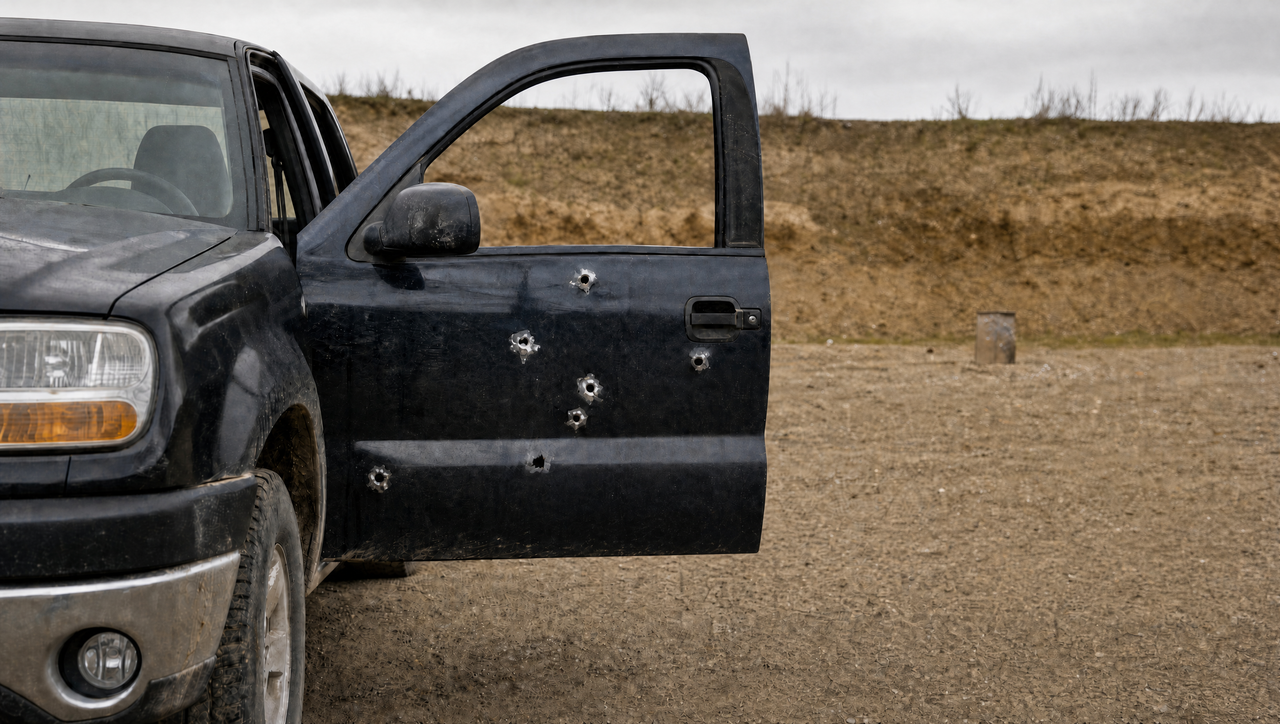
Car Doors Are Not Cover
This is the single most important thing to understand about vehicles and ballistics. A car door is concealment, not cover. It hides you from view. It does not reliably stop bullets.
A typical car door is made of a thin outer steel panel, an air gap, some internal components (window mechanisms, wiring harnesses, a moisture barrier), and a thin inner panel. The total steel thickness is roughly 20 to 22 gauge, which is about 0.030 to 0.035 inches. That's thinner than a standard metal ruler.
Most handgun ammunition will pass through a car door with enough energy to cause serious injury on the other side. Rifle ammunition goes through car doors like they're not there.
What Slows Bullets in a Car Door
The steel panels themselves provide minimal resistance. What actually affects the bullet is the collection of components inside the door: the window regulator mechanism, guide rails, speaker magnets, and side-impact reinforcement beams (in newer vehicles). A bullet that happens to hit the reinforcement beam might be deflected or fragmented. A bullet that passes through the empty space between components barely notices the door is there.
This means car doors provide inconsistent protection. You cannot predict which areas will stop or deflect a bullet and which won't.
Windshield Glass: Laminated and Unpredictable
Windshields are made of laminated safety glass: two layers of glass bonded to a plastic interlayer. This construction is designed to hold together during an impact rather than shattering into fragments. From a ballistic standpoint, it creates several problems for ammunition.
Deflection. A windshield is angled, typically 25 to 35 degrees from vertical in modern vehicles. When a bullet strikes an angled surface, it tends to deflect. Shots fired into a windshield from outside typically deflect downward. Shots fired outward from inside typically deflect upward. The steeper the angle, the more deflection.
Bullet deformation. The laminated glass strips material from the bullet and deforms the nose. Hollow points are particularly affected because the cavity can fill with glass debris before the bullet reaches tissue, which prevents normal expansion. The bullet may act more like an FMJ after passing through a windshield.
Velocity reduction. A windshield absorbs significant energy. Depending on the caliber and bullet construction, velocity reduction of 100 to 200 fps is common. Combined with deformation, this means the bullet on the other side of the glass is a very different projectile than the one that was fired.
Side and Rear Glass: Tempered
Side windows and rear windows use tempered glass, which is fundamentally different from windshield glass. Tempered glass is heat-treated to shatter into small, relatively harmless cubes on impact rather than sharp shards.
From a ballistic standpoint, tempered glass offers almost no resistance. Most handgun rounds pass through side windows with minimal velocity loss or deflection. The glass shatters on impact and the bullet continues largely unaffected.
This is worth knowing for two reasons. If you're using a vehicle's side windows as part of your defensive position, they're providing zero ballistic protection. And if you need to shoot through a side window (from inside or outside), expect your bullet to perform essentially as if the glass weren't there.
The Engine Block: Actual Cover
The engine block and the front axle/wheel assembly are the only parts of a typical passenger vehicle that reliably stop handgun and most rifle ammunition.
The engine block is a large mass of cast iron or aluminum that provides genuine ballistic protection. Positioning yourself behind the engine block (the front wheel area of the vehicle) gives you meaningful cover that a car door or trunk cannot provide.
Practical Positioning
If you're using a vehicle for cover, position yourself behind the front wheel and engine block area. The wheel itself (tire, rim, brake rotor, and hub assembly) combined with the engine behind it creates the densest barrier available on a standard vehicle.
The trunk, rear quarters, and passenger compartment offer minimal ballistic resistance. Treat them as concealment only.
How Different Bullet Types Perform Through Automotive Barriers
Full Metal Jacket (FMJ): FMJ ammunition typically penetrates automotive barriers better than expanding ammunition because the solid nose resists deformation. Through car doors, FMJ maintains its shape and trajectory reasonably well. Through windshields, it deflects but retains more of its original profile than hollow points.
Standard Hollow Points: Non-bonded hollow points are the most affected by automotive barriers. The hollow cavity fills with debris (glass, steel fragments, plastic), which prevents expansion and can cause the bullet to fragment. Through a windshield, many standard hollow points fail to expand at all and may break apart.
Bonded Hollow Points: Bonded bullets have the jacket chemically or mechanically attached to the core, preventing separation on impact. These perform significantly better through barriers than non-bonded designs. They still deform and lose expansion potential through windshields, but they hold together and maintain penetration.
Solid Copper Hollow Points: Monolithic bullets machined from solid copper tend to perform well through barriers because there's no core-jacket interface to fail. The expansion petals may fold back or break off, but the remaining projectile continues with significant mass and penetration capability.
The FBI Auto Glass Test
The FBI's ammunition testing protocol includes a specific auto glass event. The setup places a section of laminated automotive windshield glass at a 45-degree angle in front of the gel block, with the gel 18 inches behind the glass.
This test is revealing because it separates ammunition that holds together through barriers from ammunition that doesn't. Loads that perform beautifully in bare gel sometimes fail dramatically through auto glass. The best-performing defensive loads maintain adequate penetration (12+ inches in gel after the glass) and retain enough structural integrity to create a meaningful wound channel.
When you see gel test data for defensive ammunition, the auto glass event is one of the most important results to examine. If you ever need your ammunition to perform through or around a vehicle, this test is the closest simulation available.
Shooting From Inside a Vehicle
If you're inside a vehicle and need to shoot outward, the dynamics change.
Through your own windshield: The bullet passes through the glass from inside to outside. Deflection is typically upward (opposite of outside-in shots). Your point of impact will be higher than your point of aim at most engagement distances. How much higher depends on the angle of the windshield, the distance to the target, and the ammunition you're using.
Through side windows: Tempered glass shatters immediately and has minimal effect on the bullet. However, the confined space of a vehicle makes muzzle blast significantly louder and more disorienting. Without hearing protection, firing inside a vehicle will cause immediate, severe hearing damage.
Practical considerations: Drawing and presenting a firearm inside a vehicle is physically restricted by the steering wheel, seatbelt, center console, and limited space. Your available shooting positions are constrained. Training for in-vehicle defensive scenarios is specialized and different from standard range practice.
Shooting at a Vehicle From Outside
If you're engaging a threat inside or behind a vehicle from outside:
Aim points matter more than usual. A shot through the A-pillar (the structural post between the windshield and front door) hits a substantial steel support that can stop or severely deflect handgun rounds. A shot through the door panel a few inches away passes through with minimal resistance. The difference between hitting structural steel and hitting sheet metal is inches apart on the vehicle's surface.
Windshield shots require compensation. If you're shooting through a windshield from outside, your rounds will deflect downward. Some trainers teach aiming slightly high to compensate, but the amount of deflection varies with angle, distance, and ammunition, making precise compensation difficult.
Multiple barriers compound the problem. A shot that passes through a door panel, then through interior components, then through another door panel has been deflected, deformed, and slowed at each barrier. The bullet that reaches the target may bear no resemblance to the one that was fired.
What This Means for Ammunition Selection
If vehicle scenarios are part of your defensive planning (and for anyone who drives regularly, they should be), ammunition selection matters.
- Bonded or solid copper designs outperform standard hollow points through automotive barriers by a significant margin
- Penetration depth after barriers is more important than maximum expansion in bare gel when evaluating defensive ammunition for real-world carry
- FBI protocol barrier test results (especially auto glass and steel) are more relevant to your decision than bare-gel expansion photos
- Consistency through barriers matters: a load that sometimes expands and sometimes doesn't after glass is less predictable than a load that consistently performs to a known standard
The Bottom Line
Vehicles are part of daily life, and they're part of the defensive environment whether you plan for it or not. Understanding what car doors, windshields, and structural components actually do to ammunition helps you make better decisions about positioning, ammunition selection, and realistic expectations.
Car doors are concealment. The engine block is cover. Windshields deflect and deform bullets. Side glass is barely a barrier at all. And the ammunition that performs best through these obstacles is designed to hold together under stress, not just expand in ideal conditions.
Train with the assumption that barriers exist between you and reality. Choose ammunition that accounts for them.
Ammunition Built for Real Conditions
IKONICK USA defensive loads are designed for consistent performance, not just in controlled tests, but through the barriers that exist in the real world.
Shop Defensive Ammo