
Twist Rate and Bullet Stabilization: Is Your Barrel Right for Your Ammo?
Oct 23rd 2026
Twist Rate and Bullet Stabilization: Is Your Barrel Right for Your Ammo?
What Twist Rate Means
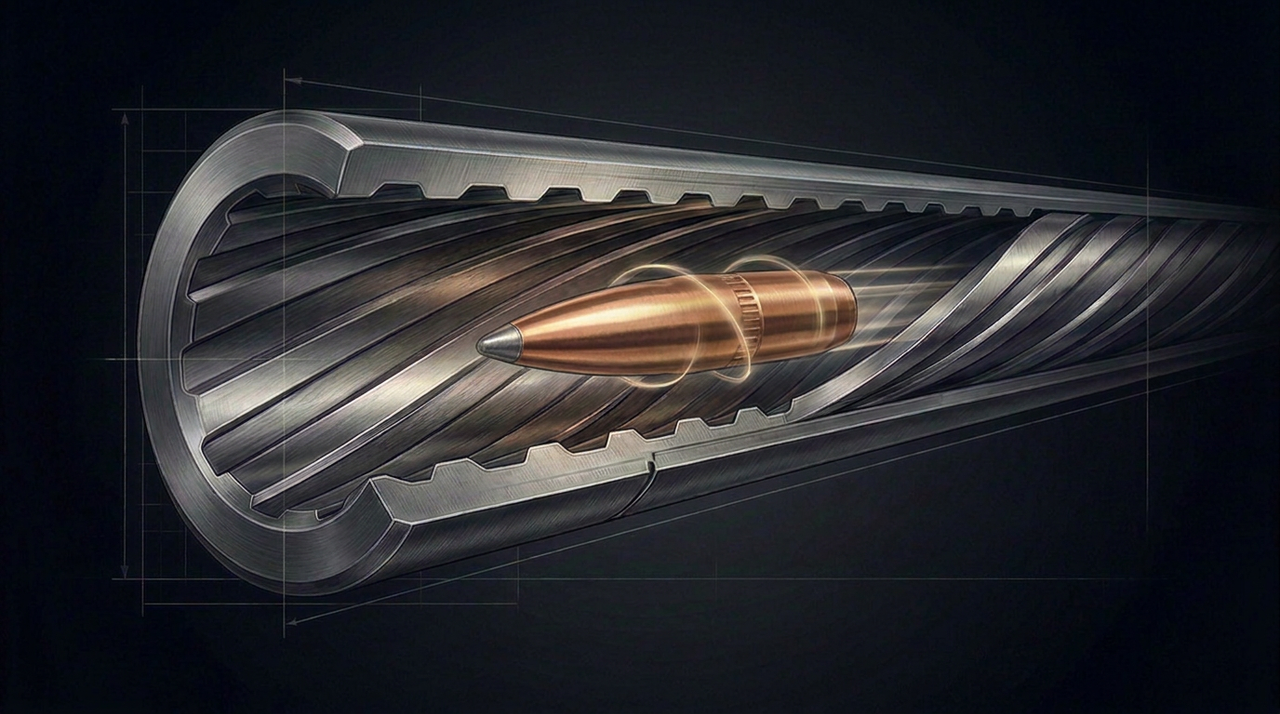
Twist rate describes how quickly the rifling in your barrel makes one complete revolution. It's expressed as a ratio: 1:10 means the rifling completes one full turn in 10 inches of barrel. 1:7 means one turn in 7 inches. The lower the second number, the faster the twist.
The purpose of the twist is to spin the bullet, and the spin is what stabilizes it in flight. A bullet that isn't spinning fast enough wobbles, tumbles, or keyholes (hits the target sideways). A bullet that's spinning appropriately flies point-forward with minimal wobble, which is what accuracy requires.
Why Bullet Weight Matters
Heavier bullets are longer than lighter bullets of the same caliber. A 77gr .223 bullet is physically longer than a 55gr .223 bullet because both are the same diameter but the heavier one contains more material, which means more length.
Longer bullets need more spin to stabilize. This is because aerodynamic forces act on the bullet's length, and a longer bullet has more surface area for those forces to work on. Without enough spin, the aerodynamic forces overcome the gyroscopic stability and the bullet begins to yaw.
This is why different twist rates exist: faster twists (1:7, 1:8) are designed for heavier, longer bullets. Slower twists (1:10, 1:12) are designed for lighter, shorter bullets.
Common Twist Rates by Caliber
.223/5.56: This is where twist rate matters most. 1:12 twist stabilizes 40 to 55gr bullets well but may not stabilize anything heavier. 1:9 handles 55 to 69gr bullets. 1:8 handles 62 to 77gr bullets. 1:7 (the military standard for M4/M16) handles 62 to 80gr+ bullets. Most modern AR-15 barrels ship with 1:7 or 1:8 twist, which covers the widest range of bullet weights.
9mm: Most 9mm pistol barrels have a 1:10 twist rate, which stabilizes the full range of common bullet weights (115gr to 147gr) without issue. Twist rate is rarely a concern for 9mm shooters.
.308: Common twist rates are 1:10 (standard, handles 147 to 175gr) and 1:12 (older barrels, best for lighter bullets). Most modern .308 barrels are 1:10, which handles the majority of available ammunition.
What Happens When the Match Is Wrong
Too slow a twist for a heavy bullet: The bullet doesn't spin fast enough to overcome aerodynamic forces. It yaws in flight, accuracy degrades rapidly at distance, and in extreme cases, the bullet keyholes at the target. This is the most common mismatch: shooting 77gr match bullets through a 1:12 twist .223 barrel.
Too fast a twist for a light bullet: This is less problematic than most people think. A fast twist will over-spin a light bullet, but in most cases, the bullet still flies accurately enough for practical use. In extreme cases (very light bullets in very fast twists), the centrifugal force can cause the bullet to come apart in flight, but this is rare with quality ammunition at normal velocities.
How to Check Your Barrel's Twist Rate
Check your firearm's manual, the manufacturer's website, or the markings on the barrel itself. AR-15 barrels typically have the twist rate stamped on them (e.g., "1:7 TWIST" or "1/7"). If you can't find it, your local gunsmith can measure it with a cleaning rod and a patch.
Matching Ammo to Your Barrel
For most shooters, this is simple: check your twist rate, then choose ammunition within the recommended bullet weight range for that twist. If you have a 1:7 twist AR-15, you can shoot everything from 55gr to 80gr+ without issues. If you have a 1:12 twist, stick with 55gr and lighter.
If you're chasing maximum accuracy, experiment within your twist rate's ideal range. A 1:8 twist .223 barrel might shoot 69gr bullets more accurately than 55gr bullets even though both are within the stable range. The only way to find your barrel's preferred bullet weight is to test different options and compare groups.
The Bottom Line
Twist rate is the relationship between your barrel and your bullet that determines whether the bullet flies straight or wobbles. Get it right and accuracy is limited by your skill. Get it wrong and no amount of skill compensates for an unstable bullet.
Know your barrel's twist rate. Choose bullet weights that match. And if your groups are opening up with a specific load, the twist rate compatibility is one of the first things to check.
Your barrel and your bullet need to agree. The twist rate is how they communicate.
Ammunition Matched to Standard Specifications
IKONICK USA ammunition uses bullet weights optimized for the most common twist rates in each caliber, delivering consistent accuracy across standard barrel configurations.
Shop Ammunition