
Recoil Management Fundamentals: Grip, Stance, and What Actually Matters
Jun 24th 2026
Recoil Management Fundamentals: Grip, Stance, and What Actually Matters
What Recoil Actually Is
Recoil is Newton's third law in action. The bullet goes forward, and an equal force pushes the gun rearward. The gas escaping the muzzle adds to this force. The total recoil impulse depends on the bullet weight, velocity, powder charge, and the weight of the firearm itself.
You can't eliminate recoil. You can only manage how it moves through the gun and into your body. The goal isn't to fight the gun; it's to let the gun move in a way you can predict and recover from quickly.
Grip: The Single Biggest Factor
If you only fix one thing about your recoil management, fix your grip. Everything else is secondary.
The strong hand wraps around the grip with the web of the hand (between thumb and index finger) as high on the backstrap as possible. The higher your hand sits, the closer it is to the bore axis, and the less leverage the recoil has to rotate the muzzle upward.
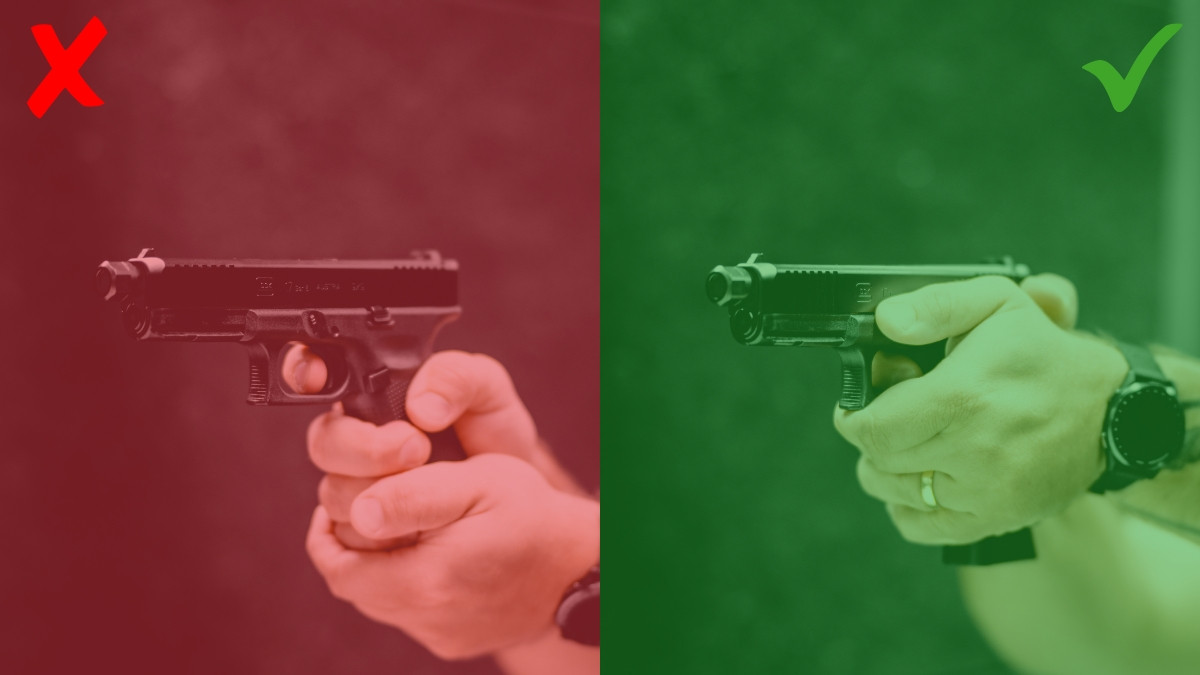
The support hand fills the remaining space on the grip. The fingers wrap around the strong hand fingers, and the heel of the support hand presses firmly into the exposed side of the grip. The support hand provides roughly 60% of the total grip force.
The Grip Pressure Test
Grip the gun as hard as you can. Now back off about 20%. That's your working grip pressure. You should be gripping hard enough that the gun doesn't shift in your hands during recoil, but not so hard that your hands shake or your trigger finger loses independence.
If your sights move when you press the trigger, you're either gripping too hard (causing sympathetic movement) or not hard enough (allowing the gun to shift under trigger pressure).
Common grip mistakes:
- Tea-cupping: Supporting the bottom of the magazine with the support hand instead of wrapping the grip. This provides zero recoil control.
- Thumbs crossed: Placing the support thumb behind the slide. On a semi-auto, this gets your thumb cut by the cycling slide. On any gun, it reduces grip contact area.
- Low grip: Holding the gun low on the backstrap. This increases the distance between your hand and the bore axis, which increases muzzle flip.
- Finger gaps: Leaving space between your hands on the grip. Every gap is a place where recoil energy escapes instead of being controlled.
Stance: Important but Overrated
Stance matters less than grip, but it still matters. The purpose of your stance is to give your body a stable platform to absorb recoil without losing balance.
What works: Feet roughly shoulder-width apart, weight slightly forward on the balls of your feet, knees slightly bent. Your upper body leans slightly forward at the waist, not dramatically, just enough that recoil pushes you back toward neutral rather than off balance.
What doesn't matter as much as people claim: The specific foot position (isosceles vs. Weaver vs. modified Weaver). All three work. The differences between them are marginal compared to the difference between a good grip and a bad grip. Pick the stance that feels natural, lets you move easily, and keeps your weight forward.
The real-world consideration: In a defensive situation, you probably won't have time to set up a perfect stance. You might be moving, crouching, leaning around cover, or shooting from a position you never practiced. A strong grip works in any position. A perfect stance only works when you have time to set it up.
Arm Position and Structure
Your arms transmit recoil from the gun to your body. How you position them affects how efficiently that transfer happens.
Elbows: A slight bend is natural and absorbs recoil better than locked-out arms. Fully locked elbows transmit all recoil force directly to your shoulders, which can cause fatigue and makes tracking the sights harder. A slight bend gives your arms a natural "spring" that helps the gun return to target.
Shoulders: Roll your shoulders slightly forward. This engages your chest and shoulder muscles, creating a more rigid frame for recoil to push against. Relaxed, pulled-back shoulders let the gun push you around.
The push-pull concept: Some shooters use a technique where the strong hand pushes the gun forward while the support hand pulls it rearward, creating isometric tension. This works well for many shooters and provides excellent muzzle flip control. Experiment with it, but don't force it if it creates tension that affects your trigger press.
Managing Muzzle Flip vs. Managing Push
Recoil has two components that feel different and require different responses:
Muzzle flip is the rotational force that pushes the front of the gun upward. It's caused by the recoil force acting below the axis of your grip. The higher you grip, the less muzzle flip. The more firmly your support hand wraps the grip, the better you control it.
Rearward push is the linear force driving the gun straight back into your hands. It's managed by your arms, shoulders, and stance. It's what pushes you off balance if your weight is too far back.
Most shooters focus on fighting muzzle flip because it's the most visible effect. But rearward push is what actually slows down your follow-up shots, because it's what disrupts your sight picture as the gun moves through the recoil cycle.
The Return to Target
Recoil management isn't about preventing gun movement. It's about getting the sights back on target as quickly as possible after the gun moves.
A well-managed recoil impulse looks like this: the gun rises, the sights lift off target, and then the gun settles back to where it started. The sights return to roughly the same spot. This happens because your grip, arm structure, and stance create a consistent path for the gun to travel during recoil and return.
An unmanaged recoil impulse looks like this: the gun jumps, the sights go somewhere unpredictable, and you have to actively search for the target and re-align the sights before your next shot.
The difference between these two outcomes is almost entirely grip. Stance and arm position help, but grip determines whether the gun returns to the same place or a different place every time.
Ammunition's Role in Recoil
Different ammunition produces different recoil characteristics, and understanding this can improve your shooting.
Lighter, faster bullets (like 115gr 9mm) produce a sharper, snappier recoil impulse. The muzzle flips up quickly and comes back quickly. Some shooters find this easier to manage because the recoil cycle is shorter.
Heavier, slower bullets (like 147gr 9mm) produce a slower, rolling recoil impulse. The gun pushes back more gradually. Some shooters find this more controllable because there's less sharp movement to react to.
Neither is objectively better. The "best" recoil feel is whichever one lets you get your sights back on target fastest. This varies by shooter, by gun, and by grip. The only way to know which works best for you is to test both.
The Practice Framework
Improving recoil management isn't about shooting more rounds. It's about shooting with intention.
Start slow. Fire one round. Watch the sights during recoil. Did they come back to target? If not, adjust your grip. Fire again. Repeat until the sights return consistently.
Add pairs. Fire two rounds as quickly as you can get an acceptable sight picture for the second shot. If the second shot is significantly off target, you're outrunning your recoil management. Slow down until both hits are where you want them.
Build speed gradually. Once pairs are consistent, add more rounds. The goal is to find the fastest pace at which you can keep all hits in an acceptable zone. That's your current speed ceiling. Train there until it becomes easy, then push faster.
Dry fire your grip. You can practice grip pressure and presentation without live ammunition. Draw the gun, establish your grip, and press the trigger. Watch the sights. If they move during the trigger press, your grip needs work.
The Bottom Line
Recoil management is a skill, not a secret technique. It's built on a high, firm grip; a forward-weighted stance; slightly bent arms with engaged shoulders; and enough practice to make the gun return to target consistently.
Grip is 80% of the equation. Fix that first. Then refine your stance, arm position, and ammunition selection to optimize the other 20%.
The shooter who practices a good grip with basic ammunition will outshoot the person with a perfect stance, locked elbows, and the "best" recoil-reducing load every single time.
Get the grip right. The rest follows.
Train With Ammo That Runs Clean
IKONICK USA Premium Range FMJ is built for high-volume training sessions. Consistent recoil impulse, reliable cycling, and clean-burning powder so you can focus on your fundamentals.
Shop Training Ammo