
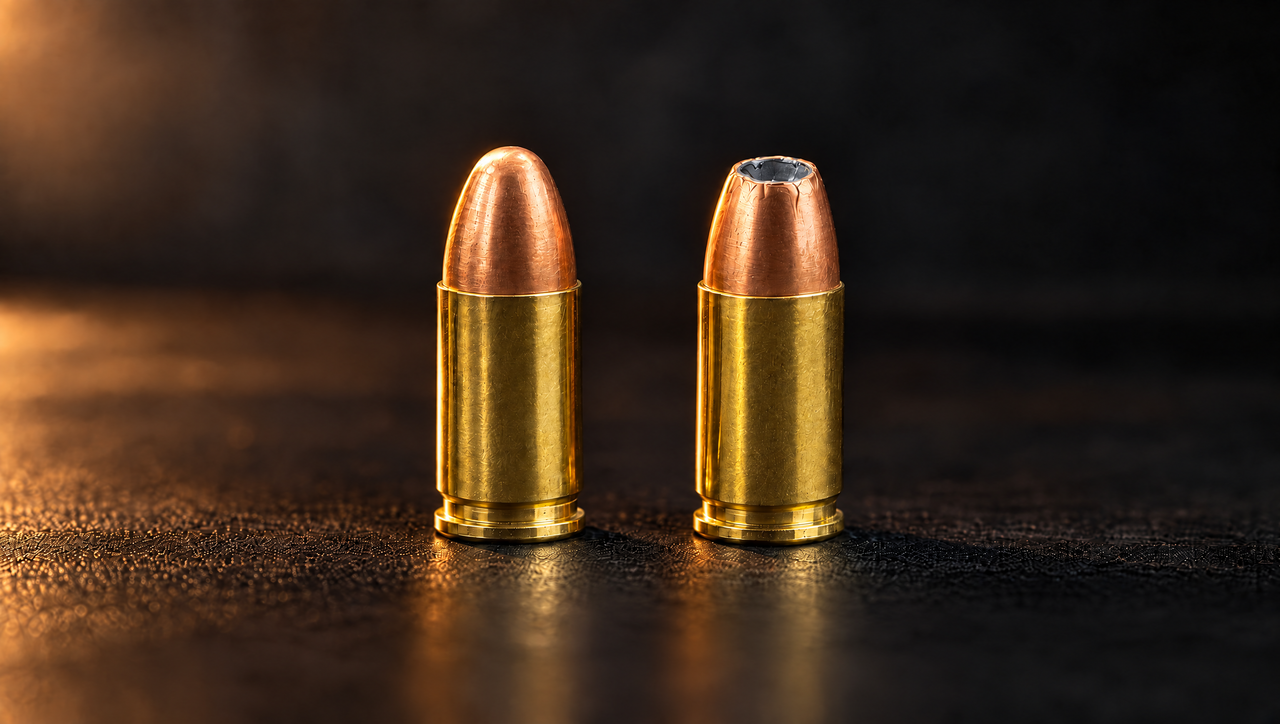
FMJ vs. Hollow Point: When to Use Each and Why It Matters
Sep 11th 2026
FMJ vs. Hollow Point: When to Use Each and Why It Matters
What FMJ Actually Is
A full metal jacket bullet has a soft lead core wrapped in a harder metal shell, typically copper or a copper alloy. The jacket covers the nose and sides of the bullet, leaving the base exposed. This design creates a bullet that holds its shape on impact rather than expanding or deforming.
FMJ ammunition feeds reliably in virtually all semi-automatic firearms because the smooth, rounded profile slides up the feed ramp without catching. It punches clean, consistent holes in paper targets. And it's significantly cheaper to manufacture than expanding ammunition, which is why it costs less per round.
What FMJ does not do is expand on impact. When an FMJ bullet hits soft tissue, it tends to pass straight through, creating a wound channel roughly the diameter of the bullet itself. This is called over-penetration, and it's the primary reason FMJ is not recommended for defensive use.
What Hollow Points Actually Do
A hollow point bullet has a cavity machined into the nose. When the bullet hits soft tissue at sufficient velocity, hydraulic pressure forces the cavity open, causing the bullet to expand like a mushroom. This expansion does two things: it creates a larger wound channel (more tissue damage) and it slows the bullet down, reducing the risk of over-penetration.
Modern hollow points are engineered to expand reliably within a specific velocity window and penetrate to a specific depth. The FBI standard of 12 to 18 inches of penetration in ballistic gel exists because that range reliably reaches vital structures from various angles while minimizing the risk of the bullet exiting the target and hitting something behind it.
Hollow points cost more because they require more precise manufacturing. The cavity geometry, jacket thickness, and bonding method all affect how consistently the bullet expands across different conditions.
When to Use FMJ
Range training and target practice. This is what FMJ was designed for. It feeds reliably, it's affordable in volume, and accuracy is consistent. If you're working on fundamentals, running drills, or putting rounds downrange for practice, FMJ is the right tool.
Competition shooting. Most competitive shooting disciplines use FMJ or similar non-expanding ammunition. The rules typically require it, and the cost savings over thousands of rounds per season are significant.
Breaking in a new firearm. When you're running the first few hundred rounds through a new gun to verify function, FMJ is the standard. It's the baseline ammunition that every firearm should cycle reliably.
Bulk stockpiling. If you're building a reserve of training ammunition, FMJ gives you the most rounds per dollar. Store it properly and it will last for decades.
When to Use Hollow Points
Concealed carry and personal defense. If the gun has any defensive role, it should be loaded with quality hollow point ammunition. The expansion and controlled penetration are what make defensive ammunition effective at stopping a threat while reducing the risk of hitting bystanders through over-penetration.
Home defense. Over-penetration matters even more inside a home where family members may be in adjacent rooms. A hollow point that expands and stops within the target is significantly safer in a residential environment than an FMJ that passes through walls.
Duty use. Law enforcement agencies almost universally issue hollow point ammunition for duty carry for the same reasons: controlled expansion, reliable penetration depth, and reduced over-penetration risk.
The Common Mistakes
Carrying FMJ for self-defense. This is the most common mistake, usually driven by cost. FMJ will absolutely stop a threat if the shot placement is right. But it will also keep going through the threat and potentially into whatever is behind them. The expansion of a hollow point is not optional in a defensive context. It's a safety feature.
Training exclusively with hollow points. Some shooters load their carry ammo and never practice with it because of the cost. You should periodically shoot your defensive ammunition to confirm it functions in your gun and to know what the recoil feels like, but your high-volume training should be done with FMJ. One or two boxes of defensive ammo through your carry gun every few months is sufficient for validation.
Assuming all hollow points are equal. A cheap, non-bonded hollow point may not expand reliably through heavy clothing or after passing through a barrier. Premium bonded or solid copper hollow points cost more but perform more consistently across real-world conditions. The gel test data matters here.
Using hollow points at the range. Unless you're specifically testing your defensive load, there's no reason to shoot hollow points at paper targets. You're spending two to three times more per round for expansion performance you don't need on a target stand.
The Cost Equation
FMJ training ammunition typically costs $0.20 to $0.35 per round for common calibers like 9mm. Defensive hollow points typically cost $0.75 to $1.50 per round for quality loads.
The practical approach: buy FMJ in volume for training (500 to 1,000 rounds at a time for the best per-round price). Buy two to three boxes of your chosen defensive hollow point for carry rotation and periodic validation. Your annual defensive ammo cost might be $60 to $90 total. Your training ammo cost depends on how often you shoot.
The two serve different purposes and should be budgeted separately. Trying to save money by carrying FMJ is a false economy when the stakes are personal safety.
The Bottom Line
FMJ is for training. Hollow points are for defense. The line between them is clear, and crossing it in either direction creates problems.
Train with affordable, reliable FMJ to build and maintain your skills. Carry quality hollow points designed to expand consistently and penetrate to the right depth. Test your defensive ammunition periodically in your carry gun. Budget for both separately.
Match the ammunition to the mission. That's the whole answer.
Training and Defense. We Build Both.
IKONICK USA offers premium FMJ training ammunition and defensive loads across popular calibers. American-made, consistent quality, built for the job.
Shop Ammunition