
Dry Fire Training: What It Can and Can't Replace
Jul 10th 2026
Dry Fire Training: What It Can and Can't Replace
What Dry Fire Actually Trains
Dry fire, at its core, is practicing the mechanics of shooting without ammunition. You're building and reinforcing the neural pathways for specific physical actions. The skills it trains effectively are the ones that don't require a bullet leaving the barrel to practice.
Trigger press. This is where dry fire shines brightest. Pressing the trigger without disturbing the sights is the single most important shooting skill, and it can be practiced entirely without live ammunition. Every dry fire rep that results in the sights staying still during the trigger press is training your brain and hands to do the right thing.
Sight alignment and sight picture. Getting your sights on target and confirming alignment is a visual and physical skill that doesn't require recoil to practice. Dry fire lets you practice acquiring the sights from the draw, from a ready position, or between simulated shots.
Draw stroke. The mechanics of drawing from a holster, establishing a grip, and presenting the gun to the target are entirely dry-fire compatible. You can run hundreds of draw reps in your living room that directly translate to faster, more consistent presentations on the range.
Reloads. Magazine changes are a mechanical skill. Dry fire with dummy rounds or empty magazines lets you practice the motor skills of dropping a magazine, inserting a new one, and getting back on target.
Target transitions. Moving the gun from one target to another and acquiring a new sight picture is a skill you can practice with multiple dry-fire targets on a wall.
What Dry Fire Cannot Train
Dry fire has real limitations, and pretending it doesn't leads to training gaps that only show up under live fire.
Recoil management. This is the biggest one. No amount of dry fire teaches your hands, arms, and body to manage the physical force of recoil. The gun doesn't move during dry fire. Your grip pressure, arm structure, and recovery technique all need live rounds to develop and maintain.
Follow-through under recoil. Calling your shot (knowing where the bullet went based on where the sights were when the gun fired) requires seeing the sights lift during recoil and tracking them back to target. Dry fire can teach you to watch the sights, but it can't replicate the visual disruption of recoil.
Flinch diagnosis. Anticipating recoil is one of the most common shooting errors, and it's invisible during dry fire because there's no recoil to anticipate. A shooter who has a perfect trigger press in dry fire might push the gun down in anticipation every time live ammunition is in the chamber.
Ammunition-specific performance. How your gun cycles, ejects, and feeds with specific ammunition can only be evaluated with live fire. Dry fire tells you nothing about reliability, point of impact, or recoil characteristics of different loads.
Noise and blast tolerance. Shooting is loud and produces concussive blast. New shooters especially need live fire exposure to develop comfort with the sensory experience of shooting. Dry fire can't replicate this.
The Flinch Problem
Dry fire is often recommended as the cure for flinching. It helps, but it's not the complete solution.
How Flinch Develops
Your body learns to anticipate recoil. Just before the trigger breaks, you tense your hands, push the muzzle down, close your eyes, or some combination of all three. This happens subconsciously and gets worse over time if uncorrected.
Dry fire helps because it lets you practice a clean trigger press without any recoil to anticipate. Your brain learns (or re-learns) that pressing the trigger doesn't require bracing for impact.
But the flinch often returns under live fire because the recoil is back. The most effective anti-flinch protocol combines dry fire with live fire, mixing snap caps (dummy rounds) randomly into your magazines so you can catch yourself flinching when you expect a bang and get a click instead.
How to Structure Effective Dry Fire
Random trigger clicks in your living room aren't training. Effective dry fire has structure, goals, and accountability.
Set a specific goal for each session. "I'm going to practice my draw to first shot in 10 reps." "I'm going to work on trigger press from a compressed ready position for 5 minutes." Specificity prevents mindless repetition.
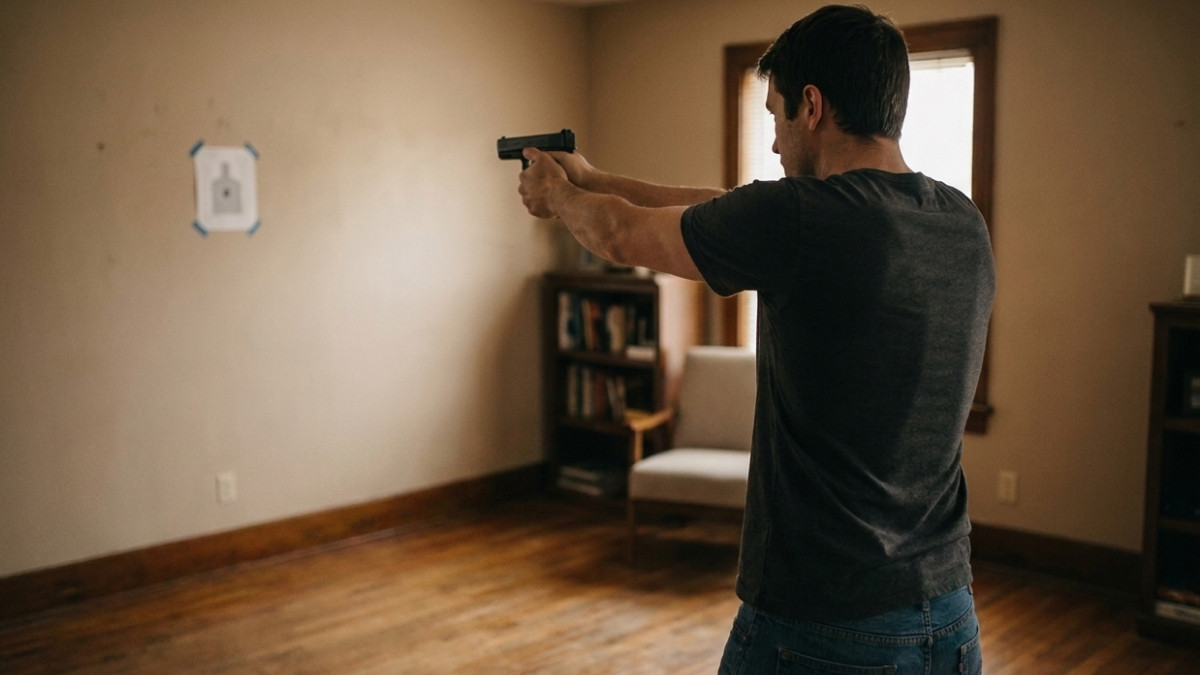
Use a target. A spot on the wall, a dry-fire target card, or an aiming point gives your sights something to align on. Without a target, you're just moving the gun around.
Keep sessions short. 10 to 15 minutes of focused dry fire is more productive than an hour of unfocused practice. Quality reps build skill. Quantity without quality builds nothing (or worse, builds bad habits).
Verify your sights every rep. If you're pressing the trigger and the sights are moving, that rep reinforced the wrong thing. Stop, reset, and do it correctly. One good rep is worth more than ten sloppy ones.
Practice at realistic speed. If you dry fire slowly and perfectly but shoot live fire as fast as possible, the skills don't transfer. Practice at a speed that challenges you but allows you to maintain correct mechanics.
Safety: The Non-Negotiable Foundation
Dry fire involves handling a firearm, and the safety rules don't take a break because there's no ammunition involved.
Dry Fire Safety Protocol
1. Remove all live ammunition from the room. Not just from the gun. From the room entirely. Magazines, loose rounds, speed loaders, everything.
2. Verify the gun is empty. Check visually and physically. Then check again.
3. Choose a safe direction. Even during dry fire, the gun should be pointed at a surface that would safely stop a bullet if you made a mistake. A concrete wall or a designated dry-fire backstop.
4. Announce "dry fire" or "clear" to yourself. This mental marker transitions your brain into training mode and reinforces that you've verified the gun is empty.
5. When you're done, stop. Don't handle live ammunition immediately after dry fire. The mental transition from "trigger press is safe" to "trigger press fires a bullet" needs a deliberate pause.
Negligent discharges during "dry fire" happen because someone skipped one of these steps. Usually step one.
The Optimal Ratio
How much dry fire vs. live fire should you be doing? There's no universal answer, but here's a practical framework:
For new shooters: Heavier emphasis on live fire initially. You need to experience recoil, learn what the gun actually feels like, and develop a baseline. Dry fire supplements live fire but doesn't replace it at this stage.
For intermediate shooters: A 3:1 or 4:1 ratio of dry fire to live fire sessions works well. You've already built the foundational live-fire skills. Now dry fire refines the mechanics (trigger press, draw, transitions) while periodic live fire sessions maintain recoil management and confirm that your dry practice is transferring.
For advanced shooters: Many competitive and professional shooters dry fire daily and shoot live only 2 to 3 times per month. At this level, the mechanics are deeply ingrained and dry fire maintains them efficiently. Live fire becomes a validation and maintenance tool rather than the primary training method.
Dry Fire Tools
You don't need expensive equipment to dry fire effectively, but a few tools can help:
- Snap caps / dummy rounds: Protect your firing pin during dry fire and allow you to practice reloads with realistic weight in the magazine
- Dry-fire target cards: Small targets designed for indoor use that give you precise aiming points
- Shot timers with par time: Set a par time and practice drawing or pressing the trigger within that window. Adds a performance standard to your practice
- Laser training systems: Devices that emit a laser pulse when the trigger is pressed, showing you where your "shot" landed. Useful for immediate feedback on trigger press quality
None of these are required. A cleared gun and a spot on the wall are enough to build real skill.
The Bottom Line
Dry fire is the most efficient way to build and maintain the mechanical skills of shooting: trigger press, sight alignment, draw stroke, reloads, and transitions. It costs nothing, requires no range time, and can be done in 10-minute sessions at home.
But it cannot replace live fire for recoil management, flinch correction, ammunition validation, or the sensory experience of shooting. Dry fire builds mechanics. Live fire validates them under real conditions.
The best shooters do both, consistently, with purpose.
Dry fire builds the skill. Live fire proves it works.
When It's Time to Validate
After your dry fire sessions, confirm your skills with live ammunition that performs consistently. IKONICK USA Premium Range FMJ gives you reliable feedback, round after round.
Shop Training Ammo