
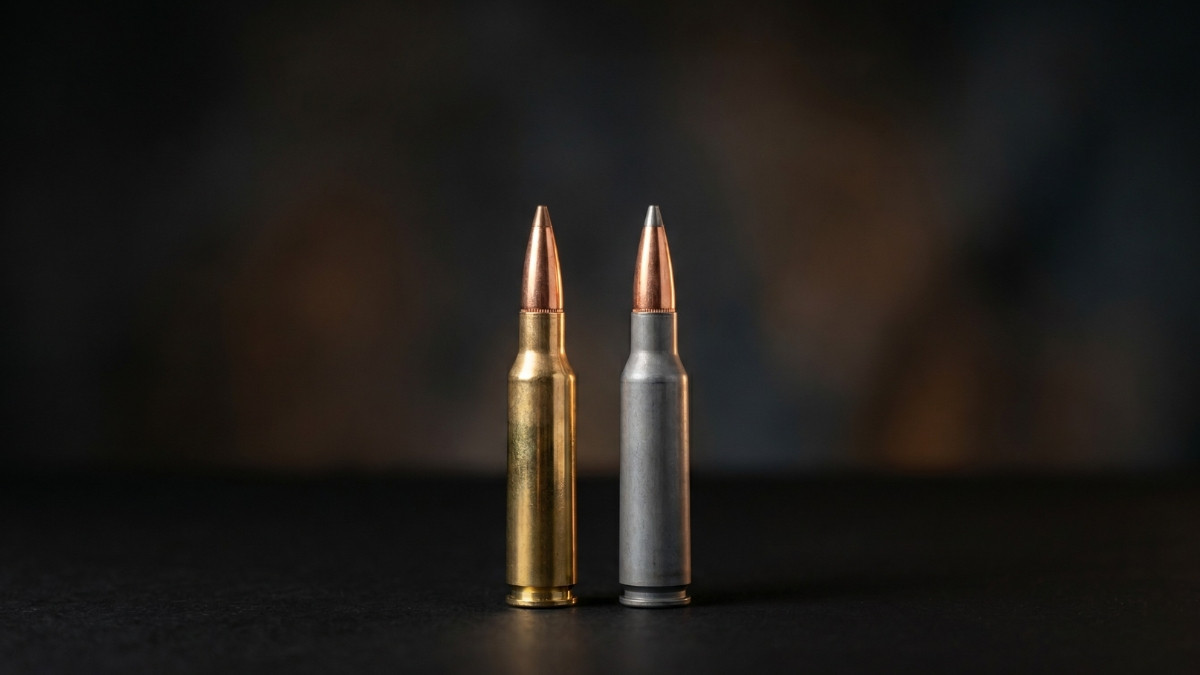
Steel Case vs. Brass Case: The Real Performance Difference
Jun 4th 2026
Steel Case vs. Brass Case: The Real Performance Difference
The Metallurgy Difference
Brass is an alloy of copper and zinc, typically in a 70/30 ratio for ammunition casings. It's naturally elastic, meaning it expands under pressure and then contracts back to near its original dimensions. This expansion-contraction cycle is what seals the chamber during firing and allows clean extraction afterward.
Steel is harder and less elastic. It doesn't expand and contract as smoothly as brass. To compensate, steel cases are typically coated with a lacquer, polymer, or zinc wash to reduce friction during extraction.
This fundamental difference in material behavior drives nearly every performance distinction between the two.
Extraction and Cycling
Brass cases expand to seal the chamber, then spring back enough for the extractor to pull them free. This happens consistently across thousands of rounds because the material is designed for this exact job.
Steel cases expand too, but they don't spring back as well. The harder material resists deformation in both directions. This means:
- Steel cases sometimes stick in the chamber longer during extraction, which increases extractor wear
- The coating on steel cases can build up residue in the chamber over time, creating additional friction
- In firearms with tight chamber tolerances (like match-grade barrels), steel cases are more likely to cause extraction issues
Most modern firearms will cycle steel-cased ammunition reliably. But "cycles reliably" and "cycles optimally" aren't the same thing. You'll notice the difference most in rapid-fire strings where the chamber heats up and tolerances tighten.
Accuracy: Is There Actually a Difference?
Yes, but it's smaller than most people claim.
Steel-cased ammunition is typically loaded with less precise components. The projectiles are often bi-metal jacketed (a steel jacket with a thin copper wash) rather than pure copper-jacketed. The powder charges may have wider tolerances. The overall quality control is looser because the product is built to a price point, not a precision standard.
The result is usually 1 to 2 MOA worse accuracy than equivalent brass-cased ammunition. At typical training distances (7 to 25 yards for pistol, 50 to 100 yards for rifle), most shooters won't notice the difference. At precision distances or when shooting for groups, it becomes visible.
The casing material itself contributes minimally to the accuracy difference. It's the overall manufacturing tolerance that matters. Cheap brass-cased ammunition can shoot just as poorly as steel, and premium steel-cased ammunition (if it existed in volume) could theoretically match brass.
Barrel Wear
This is the most debated topic in the steel-vs-brass conversation. The concern isn't actually the steel case itself; it's the bi-metal projectiles that typically come loaded in steel-cased ammunition.
What Actually Causes Wear
Bi-metal jackets (steel with a copper wash) are harder than pure copper jackets. They create more friction against the rifling as they travel down the barrel. Over thousands of rounds, this accelerates throat erosion and rifling wear.
The steel case itself doesn't contact the barrel's rifling. It sits in the chamber. Chamber wear from steel cases is minimal in most firearms.
The real question is whether the money you save on cheaper ammunition offsets the cost of replacing a barrel sooner. For most shooters, the answer is yes. For precision shooters who value barrel life, the answer is usually no.
Reloadability
Brass cases can be reloaded multiple times. Quality brass might survive 5 to 10 reloading cycles before the material fatigues.
Steel cases cannot be practically reloaded. The material work-hardens after firing and doesn't resize well in standard reloading dies. The primer pockets are also typically crimped in a way that makes repriming difficult.
If you reload your ammunition, brass is the only option. If you don't reload and never plan to, this difference doesn't affect you directly. But it does affect the brass market: steel-cased ammunition produces no reusable brass, which is why ranges that sort and sell brass sometimes restrict or surcharge for steel-cased ammunition.
The Cost Calculation
Steel-cased ammunition typically costs 20 to 40% less per round than brass-cased equivalents. On a per-session basis, that adds up.
Example: 9mm Training Over One Year
200 rounds per month, 2,400 rounds annually
Brass at $0.30/round: $720/year
Steel at $0.20/round: $480/year
Annual savings: $240
That $240 buys a lot of extra range time, training classes, or other gear. The question is whether the extraction wear, accuracy reduction, and lack of reloadability are worth that savings for your specific situation.
Reliability Considerations
Some firearms run steel-cased ammunition without issue. Others don't. The variables include:
- Chamber finish: Chrome-lined chambers handle steel cases better than unlined chambers because the chrome reduces friction
- Extractor design: Some extractors grip steel cases less securely than brass, leading to occasional failures to extract
- Magazine springs: Steel-cased rounds are slightly heavier overall, which can affect feeding in magazines with weak springs
- Gas system timing: In semi-automatic rifles, the different pressure curve of steel-cased ammunition can cause short-stroking in some gas systems
The only way to know if your specific firearm handles steel reliably is to test it. Don't assume based on what other shooters report with different guns.
When Steel Case Makes Sense
- High-volume training where you're burning through hundreds of rounds per session and cost is a real constraint
- Firearms with chrome-lined chambers that handle steel extraction without issues
- Casual plinking where precision doesn't matter and you just want trigger time
- AK-pattern rifles and other platforms specifically designed around steel-cased ammunition
When Brass Case Makes Sense
- Defensive or duty ammunition where reliability is non-negotiable
- Precision shooting where accuracy margins matter
- Firearms with tight chambers (match barrels, competition guns) that don't tolerate extraction variance
- Reloading where you want to reuse the brass
- Reliability testing your carry gun, because you need to know the gun runs perfectly, not just "usually"
The Bottom Line
Steel-cased ammunition is a legitimate option for budget-conscious training. It works in most modern firearms and saves real money over thousands of rounds.
Brass-cased ammunition is the better-performing option in every measurable way: extraction, accuracy, barrel wear, reloadability, and overall consistency. The premium you pay for brass buys you reliability and precision that steel can't match.
For most shooters, the practical approach is straightforward: train with whatever your gun runs reliably and your budget allows, but carry brass. When it matters, you want the material that was designed from the ground up to perform under pressure.
Your firearm doesn't care about the price per round. It cares about whether the case expands, seals, and extracts the way it's supposed to.
Premium Brass. Consistent Performance.
IKONICK USA ammunition is loaded exclusively in brass cases with tight manufacturing tolerances for reliable extraction, consistent accuracy, and maximum reloadability.
Shop Ammunition