
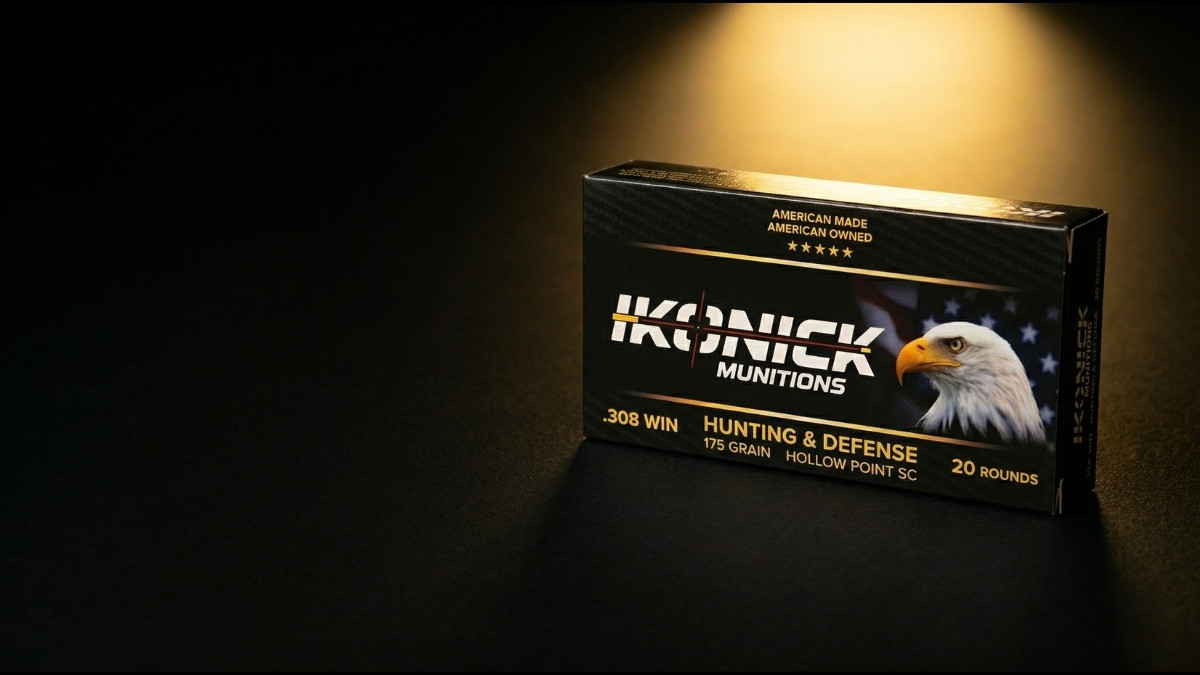
What the Numbers on Your Ammo Box Actually Mean
May 28th 2026
What the Numbers on Your Ammo Box Actually Mean
The Caliber Designation
The biggest number on the box is usually the caliber. This tells you what firearm the ammunition fits. But caliber designations aren't as straightforward as they seem.
Decimal-based calibers (like .223, .308, .45 ACP) refer to the approximate bullet diameter in inches. A .308 Winchester fires a bullet that's roughly 0.308 inches in diameter. A .45 ACP fires one that's roughly 0.452 inches.
Metric calibers (like 9mm, 6.5 Creedmoor) use millimeters for the bullet diameter. 9mm means the bullet is approximately 9 millimeters across. The 6.5 in 6.5 Creedmoor means 6.5mm.
The name after the number identifies the specific cartridge. This matters because multiple cartridges can share the same bullet diameter. .308 Winchester and .300 Blackout both use .308-caliber bullets, but they're completely different cartridges that are not interchangeable. The full name on the box is what you match to your firearm, not just the bullet diameter.
Common Designations Decoded
9mm Luger (9x19mm Parabellum): The world's most popular pistol cartridge. All three names refer to the same round.
.223 Remington vs. 5.56 NATO: Very similar but not identical. 5.56 NATO is loaded to higher pressure. Most modern rifles chambered in 5.56 can safely fire .223, but not always the other way around. Check your firearm's manual.
.308 Winchester vs. 7.62x51 NATO: Similar relationship to .223/5.56. The .308 is the commercial version, 7.62 NATO is the military spec.
ACP: Stands for "Automatic Colt Pistol." You'll see it on .45 ACP, .380 ACP, and others.
Grain Weight
The number followed by "gr" on your ammo box is the bullet weight, measured in grains. One grain equals 1/7,000th of a pound. It's a small unit of measurement because bullets are light objects where small weight differences create meaningful performance changes.
What grain weight tells you:
- Heavier bullets (higher grain) generally move slower, hit harder at close range, and produce a different recoil feel. They tend to penetrate deeper.
- Lighter bullets (lower grain) generally move faster, shoot flatter at distance, and produce snappier recoil. They may expand more aggressively on impact.
Common Grain Weights by Caliber
9mm: 115gr (light/fast), 124gr (balanced), 147gr (heavy/subsonic)
.223 / 5.56: 55gr (standard), 62gr (heavier, better barrier performance), 77gr (precision/match)
.308: 147gr (light/fast), 168gr (match standard), 175gr (long-range precision)
.300 Blackout: 110-125gr (supersonic), 200-220gr (subsonic)
There's no universally "best" grain weight. The right choice depends on your firearm, your barrel length, and what you're using the ammunition for.
Bullet Type Abbreviations
After the grain weight, you'll usually see an abbreviation describing the bullet's construction. This tells you what the bullet is designed to do.
FMJ (Full Metal Jacket): A lead core wrapped in a copper jacket. The standard for training and range use. Designed to feed reliably and punch clean holes. Not designed to expand on impact.
HP (Hollow Point): A bullet with a cavity in the nose designed to expand on impact, creating a larger wound channel. The standard for defensive and duty ammunition.
FMJBT (Full Metal Jacket Boat Tail): An FMJ with a tapered base for better aerodynamics. Common in rifle ammunition for improved accuracy at distance.
SCBT (Solid Copper Boat Tail): A bullet machined from solid copper rather than a lead core with a copper jacket. Typically used in premium hunting and defense loads. Retains weight better on impact than traditional lead-core designs.
JHP (Jacketed Hollow Point): A hollow point with a copper jacket. Most modern defensive ammunition falls into this category.
SP (Soft Point): A bullet with an exposed lead tip that expands on impact but more gradually than a hollow point. Common in hunting ammunition.
Velocity Ratings
Some boxes list muzzle velocity in feet per second (fps). This is the speed of the bullet as it leaves the barrel.
What to know about published velocity:
The number on the box is measured from a specific test barrel length, usually noted in small print. If your barrel is shorter than the test barrel, your actual velocity will be lower. If your barrel is longer, it may be slightly higher.
Velocity Context
Under 1,100 fps: Subsonic. The bullet stays below the speed of sound. Quieter when suppressed.
1,100 to 1,400 fps: Typical pistol velocity range for most defensive and training loads.
2,500 to 3,200 fps: Typical rifle velocity range for most centerfire cartridges.
Velocity matters because it affects trajectory (how much the bullet drops over distance), energy (how hard it hits), and terminal performance (how it behaves on impact). But velocity alone doesn't tell the whole story. A fast, lightweight bullet and a slow, heavy bullet can carry similar energy while performing very differently.
Muzzle Energy
Listed in foot-pounds (ft-lbs), muzzle energy represents how much kinetic energy the bullet carries as it leaves the barrel. It's calculated from bullet weight and velocity.
Higher energy generally means more potential for tissue damage on impact, but energy numbers can be misleading without context. A bullet that fragments on contact might transfer energy quickly but penetrate poorly. A bullet that holds together might carry less total energy but penetrate deeper and more reliably.
Energy is a useful comparison tool within the same caliber, but comparing energy across different calibers or bullet types without considering penetration and expansion doesn't tell you much.
Lot Numbers
Somewhere on the box, usually on the end flap or bottom, you'll find a lot number. Most shooters ignore this entirely, but it serves two important purposes.
Quality tracking. The lot number identifies a specific production run. If a manufacturer discovers a quality issue, the lot number allows them to trace which boxes are affected and issue targeted recalls instead of pulling everything off shelves.
Consistency tracking. Precision shooters record lot numbers because ammunition from the same production run tends to be more consistent than ammunition from different runs. If you find a lot that shoots exceptionally well in your gun, buying more from that lot (if available) gives you the best chance of repeating that performance.
For most shooters, lot numbers are something you note and file away. You probably won't need them. But if you ever experience a malfunction or need to contact the manufacturer about a quality issue, having the lot number speeds up the process significantly.
Round Count
The box will tell you how many rounds are inside. Common counts vary by caliber and intended use:
- 20 rounds: Standard for most rifle ammunition and premium defensive handgun loads
- 50 rounds: Standard for most handgun training and range ammunition
- Bulk packs (100, 200, 500, 1000): Training ammunition sold in higher volumes at a lower per-round cost
The round count combined with the price gives you your cost per round, which is the most useful number for comparing value across different brands and retailers.
You may also see ammunition sold by the gross. A gross is 144 rounds, or 12 dozen, a counting term borrowed from wholesale trade. Modern boxes are packed in 20s and 50s, so it mostly shows up in bulk listings. To compare a gross to a 50 round box, divide its price by 144 to get the cost per round.
Pressure Ratings and Overpressure Markings
Some ammunition is marked +P or +P+. This indicates the ammunition is loaded to higher-than-standard pressure.
+P ammunition is loaded to pressures roughly 10% above standard. It produces higher velocity from the same bullet weight, which can improve terminal performance. Most modern firearms rated for +P can handle it safely, but check your owner's manual.
+P+ ammunition exceeds even +P pressure standards. It's less common and not all firearms are rated for it. This is typically law enforcement or specialty ammunition.
Higher pressure means more wear on your firearm over time. It's fine for defensive carry ammunition that you rotate periodically, but shooting thousands of +P rounds through a compact pistol will accelerate wear on the barrel, frame, and recoil spring.
The Bottom Line
The numbers on your ammo box aren't marketing. They're specifications that tell you exactly what's inside and how it's designed to perform.
The caliber tells you what gun it fits. The grain weight tells you how the bullet is balanced between speed and mass. The bullet type tells you what it's designed to do on impact. The velocity and energy tell you how it performs out of a specific barrel length. The lot number gives you traceability.
You don't need to memorize all of this. But understanding what you're buying, and why one box costs more than another, makes you a better-informed shooter and a smarter consumer.
Read the box. Know what you're feeding your firearm.
Ammunition Worth Understanding
Every box of IKONICK USA ammunition is clearly marked with caliber, grain weight, bullet type, and lot number. American-made, fully traceable, built to spec.
Shop Ammunition