
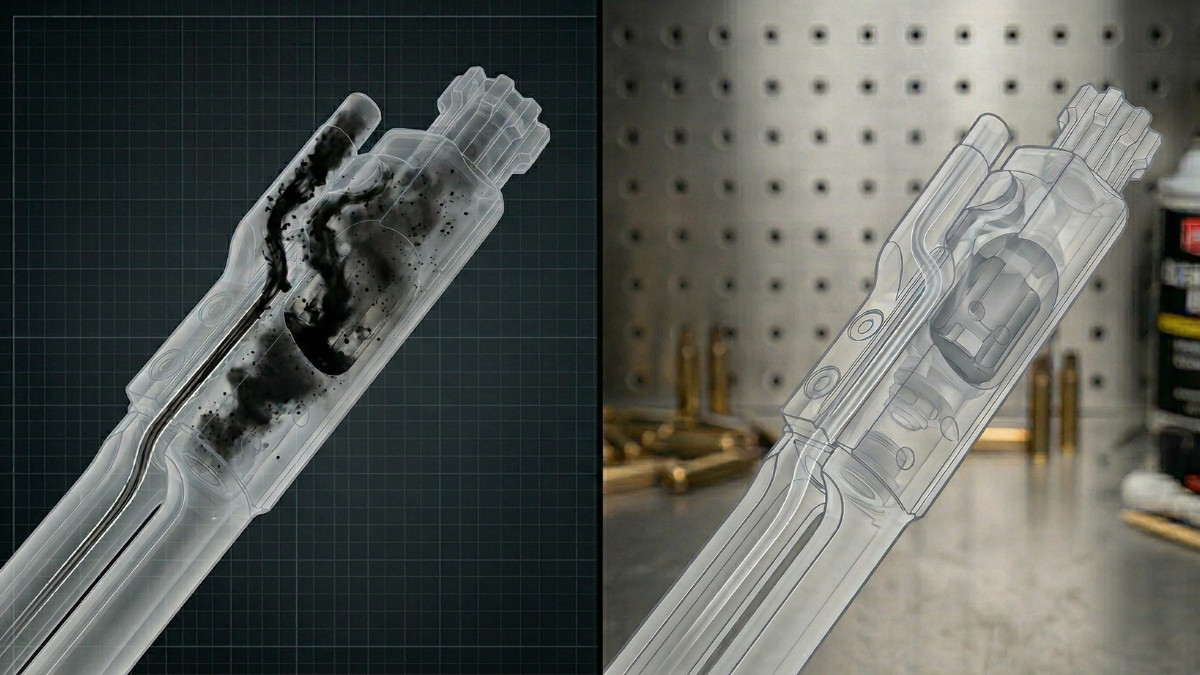
Powder Selection: Why Clean-Burning Isn't Just Marketing
Apr 2nd 2026
Powder Selection: Why Clean-Burning Isn't Just Marketing
The answer: it's one of the most underrated factors affecting your firearm's long-term performance and your maintenance schedule. Here's what's really happening inside your gun, and why powder quality deserves more attention than it gets.
What "Clean-Burning" Actually Means
All gunpowder produces residue when it burns. The question is: how much, and what kind?
Traditional powders leave behind three types of fouling:
Carbon residue from incomplete combustion - this is the black coating you see on your bolt face and chamber walls.
Copper and lead deposits from the bullet (not the powder's fault, but cheap powder can make it worse by creating uneven pressure that increases jacket stripping).
Unburned powder flakes that didn't fully combust before the bullet left the barrel.
"Clean-burning" powder is engineered to achieve more complete combustion within the pressure and time constraints of your specific cartridge. This means more energy goes into pushing the bullet, and less residue sticks around as carbon buildup.
But the real benefit isn't that your gun looks prettier after 500 rounds, it's what happens to reliability and barrel life when that carbon accumulates.
Carbon Buildup: The Slow-Motion Malfunction
Here's the thing about carbon: it's not inert. When it builds up in critical areas, it changes how your gun functions.
How Carbon Affects Your Firearm
Chamber fouling increases friction during extraction. What starts as smooth cycling gradually becomes draggy, slowing your slide velocity and increasing felt recoil. In semi-autos, this can lead to short-stroking and failures to eject.
Gas port restrictions (in rifles) reduce the pressure available to cycle the action. Your rifle that ran flawlessly at round 50 starts short-stroking at round 800 because the gas port has narrowed from carbon deposits.
Locking lug galling happens when carbon particles act as an abrasive between tight-fitting metal surfaces. Over thousands of rounds, this accelerates wear and can affect headspacing.
The sneaky part? This degradation happens gradually enough that you don't notice. You just start accepting that your gun "needs more frequent cleaning" or "runs better when it's wet." What you're really experiencing is the cumulative effect of powder quality.
Barrel Life and Heat Stress
Every time you fire a round, your barrel experiences thermal stress. The barrel heats, expands slightly, then contracts as it cools. Repeat this a few thousand times and you start seeing throat erosion.
Here's where powder chemistry enters the picture:
Flame temperature varies significantly between powder formulations. Hotter-burning powders (often used in cheap ammunition to maximize velocity) accelerate throat erosion. You'll hit that 10,000-round barrel lifespan faster with hot, dirty powder than with cooler-burning, efficient powder.
Burn rate consistency determines how evenly that thermal stress distributes. Inconsistent powder, which is often the same powder that burns dirty, creates uneven heating patterns that accelerate cracking and erosion at specific points in the throat.
Residue insulation is a weird one: as carbon builds up in the throat, it actually acts as an insulator, which changes the heat distribution pattern. Barrels that run dirty develop hot spots faster than clean-burning ammunition.
You're probably not tracking your round count precisely enough to notice the difference between a 10,000-round barrel and a 12,000-round barrel. But if you shoot competitively or use your firearm professionally, that 20% improvement in barrel life has real dollar value.
The Maintenance Interval Reality
Let's talk practically: how often do you actually need to clean your gun?
With high-quality, clean-burning ammunition, most modern semi-automatic pistols can run 1,000+ rounds between cleanings without reliability issues. You'll see fouling, but it won't affect function.
With cheap, dirty-burning ammunition? You might start seeing malfunctions around round 500. Maybe sooner in humid environments where carbon attracts moisture and accelerates corrosion.
Here's the calculation that matters: if you're shooting 200 rounds per range session, clean-burning ammunition means you can train for five sessions before a deep clean. Dirty ammunition might require cleaning after every other session.
That's not about laziness, it's about the opportunity cost of spending an hour cleaning instead of an hour dry-firing, reading, or doing anything else productive.
Gas Guns: Where Powder Quality Matters Most
Direct impingement AR-15s are notorious for getting dirty. That's by design; the gas system intentionally vents combustion gases back into the action to cycle the bolt.
But not all gases are created equal:
Clean-burning powder produces less particulate matter, which means less carbon buildup on your bolt carrier group, firing pin, and cam pin. Your rifle runs longer between cleanings and experiences less wear on critical surfaces.
Dirty powder turns your bolt carrier into a carbon-caked mess within a few hundred rounds. Worse, that carbon can gum up your firing pin channel, leading to light primer strikes or even slam-fires if the pin doesn't move freely.
Piston-driven rifles fare better because they don't dump exhaust into the action. But even they suffer from dirty powder through carbon buildup in the barrel and gas port restrictions.
If you shoot an AR platform seriously, whether for competition, training, or duty use, the difference between clean and dirty ammunition isn't academic. It's the difference between running 1,500 rounds in a class without cleaning versus needing to detail-strip your bolt at the lunch break.
The Accuracy Connection
Here's something most shooters don't consider: carbon fouling changes your barrel's interior dimensions over the course of a string.
Your first cold-bore shot goes through a relatively clean barrel. By shot 50, there's a layer of carbon coating the rifling. By shot 150, that layer has thickened noticeably.
Consistent fouling (from quality powder) means your point of impact shifts predictably. You might see your group move slightly, but it stays tight.
Inconsistent fouling (from cheap powder) means shot-to-shot variations as carbon deposits unevenly. One round might experience more friction than the next, changing barrel harmonics and bullet exit timing.
For precision rifle work, this is why serious shooters develop load data for both fouled and clean barrels. They're accounting for the fact that the barrel's effective dimensions change with carbon buildup.
But with truly clean-burning powder? That shift happens more gradually and predictably, which means your zero holds longer and your groups stay consistent deeper into a string.
How to Tell What You're Getting
Most manufacturers don't publish their powder specifications. But you can evaluate powder quality through observation:
Residue color: Gray or light-colored residue indicates better combustion than heavy black carbon.
Residue texture: Powder-like residue brushes away easily. Gummy, tarry buildup indicates poor combustion chemistry and possibly added graphite or molybdenum coatings.
Smell: Yes, really. Clean-burning powder produces a sharper, less acrid smell. Dirty powder smells like burnt rubber or tar.
Consistency: Does every round leave similar residue, or does fouling seem random? Consistent fouling means quality control, even if it's dirty powder, at least it's consistently dirty.
The Bottom Line
"Clean-burning powder" isn't marketing fluff. It's shorthand for a powder formulation that achieves more complete combustion within your barrel's constraints, which translates to:
- Longer intervals between cleaning
- Reduced barrel wear and extended barrel life
- More consistent accuracy as the barrel fouls
- Better reliability in high-volume shooting
- Less wear on extraction and cycling components
You don't need to obsess over powder chemistry. But understanding that ammunition manufacturers face real tradeoffs, and that some choose to optimize for cost while others optimize for performance, gives you the context to make informed purchasing decisions.
Cheap ammunition has its place. But if you're using that gun for anything that matters, the extra dollar per box for clean-burning powder isn't a premium feature. It's an investment in your firearm's longevity and your training efficiency.
Your barrel will thank you around round 8,000. Your bolt will thank you around round 1,200. And your cleaning rod will thank you after every range session.
Experience Clean-Burning Performance
IKONICK USA ammunition is loaded with advanced clean-burning powders engineered for maximum combustion efficiency, extended barrel life, and reduced maintenance intervals.
Shop Ammunition