
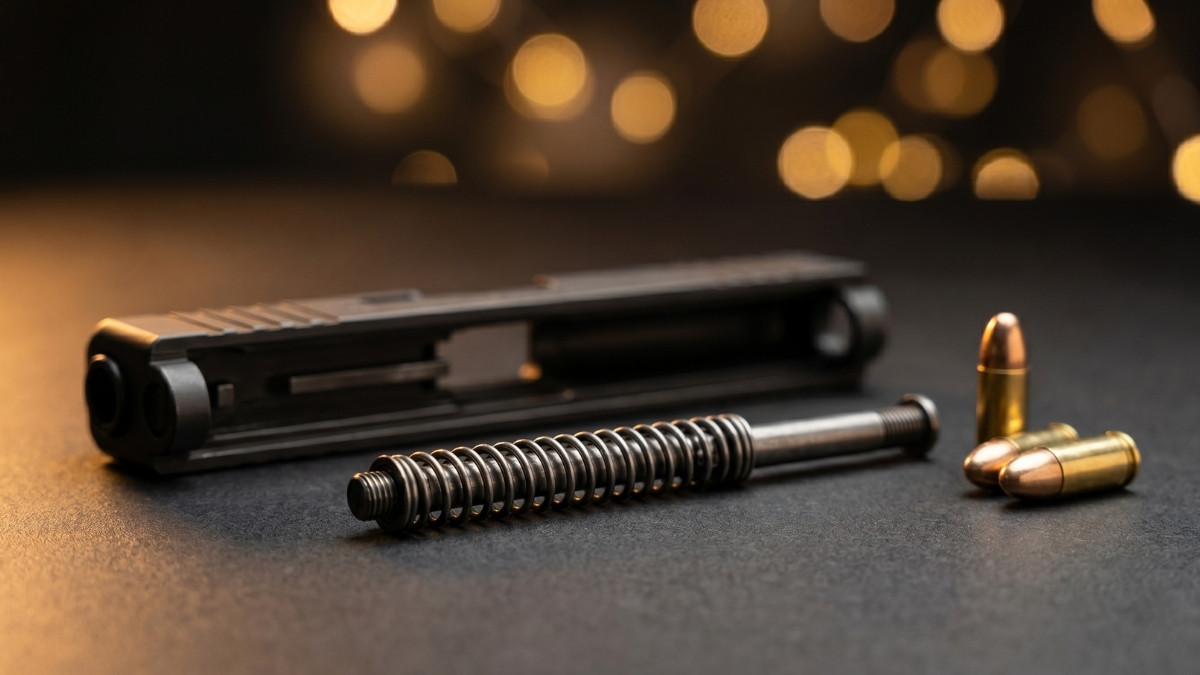
How Your Recoil Spring Affects Ammunition Performance
Jun 12th 2026
How Your Recoil Spring Affects Ammunition Performance
What the Recoil Spring Actually Does
When you fire a round, expanding gases push the bullet forward and the slide (or bolt) rearward simultaneously. The recoil spring's job is to absorb that rearward energy, stop the slide before it damages the frame, and then push the slide forward to strip a new round from the magazine and lock it into battery.
The spring has to do all of this within a very specific timing window. Too fast or too slow and the action doesn't cycle correctly.
This means your recoil spring is tuned around a specific pressure curve. The factory spring weight is chosen based on the ammunition the manufacturer expects you to shoot: standard-pressure, standard-weight loads in that caliber.
Spring Weight and Slide Velocity
Recoil spring weight is measured in pounds. A heavier spring provides more resistance to the slide's rearward movement. A lighter spring provides less.
The Relationship
Heavier spring + standard ammo: Slide moves rearward more slowly. May not travel far enough to pick up the next round. Potential failure to feed.
Lighter spring + standard ammo: Slide moves rearward faster and harder. Increased battering on the frame. Potential for the slide to bounce off the rear stop and create feeding issues.
Factory spring + standard ammo: The slide travels at the speed and distance the gun was designed for. Everything cycles as intended.
This balance is why changing your recoil spring or changing your ammunition (without adjusting the other) can create reliability problems that seem random but are actually predictable.
How Different Ammunition Loads Interact with Your Spring
Not all ammunition generates the same recoil impulse. The pressure curve, bullet weight, and powder charge all affect how much force pushes the slide rearward.
Hot loads (+P or high-velocity): These generate more rearward force than standard loads. With a factory-weight spring, the slide moves faster and farther. In most guns, this is within the design margin. But in compact pistols with shorter slide travel, +P ammunition can cause the slide to slam rearward harder than intended, accelerating wear on the frame and recoil spring.
Light loads (reduced recoil or subsonic): These generate less rearward force. With a factory spring, the slide might not travel far enough rearward to reliably strip a round from the magazine. This is why some shooters experience failures to feed with subsonic ammunition in guns designed for standard-pressure loads.
Different bullet weights: A 115gr bullet at 1,150 fps and a 147gr bullet at 950 fps generate different recoil impulses even though they're both 9mm. The heavier bullet pushes the slide with a slower, longer force. The lighter bullet pushes it with a sharper, quicker force. Your spring responds differently to each.
When Aftermarket Springs Make Sense
There are legitimate reasons to change your recoil spring weight:
Suppressor use. A suppressor increases back-pressure, which pushes the slide rearward harder. Many suppressor-equipped pistols need a slightly heavier recoil spring to slow the slide down and prevent excessive battering.
Competition shooting. Competition shooters often use lighter recoil springs paired with lighter loads to reduce felt recoil and speed up slide cycling. This is a deliberate system tuning, not just swapping one component.
Dedicated subsonic use. If you're running subsonic ammunition exclusively (for suppressed shooting, for example), a lighter spring can improve cycling reliability with lower-pressure loads.
Compensator use. Compensators vent gas upward to reduce muzzle rise, but they also reduce the gas available to push the slide rearward. A lighter spring compensates for this.
The Critical Rule
If you change your recoil spring, you need to re-validate your ammunition. A spring swap that makes your gun run perfectly with 124gr training ammo might cause failures with your 147gr defensive load. Every spring change requires a new reliability test with every ammunition type you plan to use.
Spring Fatigue: The Wear You Don't See
Recoil springs are consumable parts. They lose tension over time and use. A spring that was perfectly tuned at 1,000 rounds might be slightly weak at 5,000 rounds and noticeably weak at 10,000.
As the spring weakens, it behaves like a lighter spring: the slide travels faster and farther rearward. You might start experiencing:
- Brass ejecting farther or more erratically than when the gun was new
- The slide locking back on a loaded magazine (the slide is traveling so far rearward that it catches the slide stop)
- Increased felt recoil as the slide hits the frame harder
- Feeding issues as the slide's return speed changes
These symptoms often get blamed on ammunition when they're actually a worn spring changing the timing of the entire system.
Replacement Intervals
There's no universal round count for spring replacement. It varies by firearm, spring design, and the ammunition you shoot. General guidelines:
- Full-size pistols: Every 3,000 to 5,000 rounds for most factory springs
- Compact and subcompact pistols: Every 2,000 to 3,000 rounds (shorter springs fatigue faster)
- Competition guns with aftermarket springs: Follow the spring manufacturer's recommendation, which is often more frequent than factory intervals
- Rifles: AR-15 buffer springs typically last 10,000+ rounds, but performance degrades gradually
The best approach: replace your recoil spring on a schedule rather than waiting for symptoms. By the time you notice reliability changes, the spring has been degrading for hundreds of rounds.
The System Thinking Approach
Your firearm is a system. The recoil spring, ammunition, magazine spring, and extractor all work together in a timed sequence. Changing any one component affects the others.
If you change ammunition brands or bullet weights and start experiencing reliability issues, the recoil spring is the first place to look. If you install an aftermarket spring, you need to test your ammunition again. If you've been shooting the same setup for thousands of rounds without changing the spring, it might be time for a fresh one.
The ammunition didn't change. The spring did.
The Bottom Line
Your recoil spring is calibrated for a specific range of ammunition performance. Stay within that range and the gun runs. Step outside it, with hotter loads, lighter loads, or a worn spring, and you introduce variables that affect everything from feeding to extraction to felt recoil.
Most reliability problems that get blamed on ammunition are actually spring-related. Either the spring is worn, it's the wrong weight for the load being fired, or it was changed without re-validating the ammunition.
Understand the relationship between your spring and your ammo, and most "random" malfunctions stop being random.
The spring sets the tempo. The ammunition follows it.
Ammunition That Runs in Factory Configurations
IKONICK USA ammunition is loaded to standard pressure specs designed to cycle reliably with factory recoil springs across a range of firearm platforms.
Shop Ammunition